
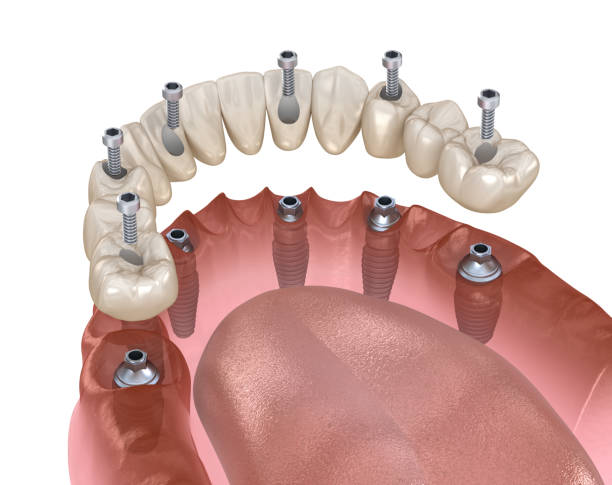
If one implant fails under a full-arch bridge, the entire restoration does not automatically need replacing. The outcome depends on which implant failed and its condition. It also depends on the health and position of the remaining implants, the supporting bone, and the bridge’s design.
A full-arch bridge may rest on four, five, six, or more implants. Because one implant-supported bridge connects them all, losing a single support raises a fair question. Can the rest of the restoration keep working?
Not every problem that feels like full-arch implant failure actually is one. A loose screw, abutment, or bridge component may be repairable. An implant with a biological problem may be treatable. When an implant has truly failed, the care team must decide whether the bridge can be kept, modified, or replaced. The original design should not be assumed safe after it loses support.
Shoreline Periodontics evaluates concerns about full-arch dental implants in Middletown, CT, for patients across Middlesex County. That includes suspected All-on-4 implant failure.
Key Takeaways
- Losing one supporting implant does not automatically mean losing the whole full-arch bridge.
- A loose bridge, screw, or abutment is not necessarily a failed implant.
- Where the failed implant sits can matter as much as how many implants remain.
- A four-implant bridge that loses one support should not be assumed safe on the remaining three.
- The existing bridge can sometimes be modified or included in a new treatment plan.
- A periodontist and restorative clinician should assess the whole system before treatment.
How Do Multiple Dental Implants Support a Full-Arch Bridge?
A full-arch implant restoration works as a connected prosthetic system. Several implants share the job of supporting one continuous bridge.
What Is an Implant-Supported Full-Arch Dental Bridge?
A fixed full-arch prosthesis replaces all the teeth in an upper or lower arch. Each implant fixture is a screw-shaped post anchored in the jawbone. Abutments connect the fixtures to the bridge, and prosthetic screws hold it in place. A rigid framework carries the artificial teeth, which are separate from the implants beneath them. Front (anterior) and back (posterior) implants each support a different part of the bridge.
What Happens to the Original Prosthetic Design When One Support Is Lost?
The bridge was designed for a specific support arrangement, and losing one implant changes it. Planning often starts with how many implants support a full-arch bridge. After a failure, clinicians must reassess where the remaining supports sit before deciding whether the bridge can keep working.
Does One Failed Dental Implant Mean the Entire Full-Arch Bridge Has Failed?
No, not necessarily. A failed implant, a loose component, and a failed bridge are different problems. They can be related, but each needs its own diagnosis.
This table is a general overview, not a diagnosis.
| Clinical Situation | Possible Treatment Direction | Whole Bridge Automatically Replaced? |
| Loose screw, stable implants | Repair the component and find the cause | No |
| Stable implant with treatable peri-implant disease | Control the disease and reassess | No |
| Failed implant under an intact bridge | Assess removal, support, and bridge modification | Not necessarily |
| One failed implant in a four-implant bridge | Reassess the full support and restorative plan | Not safe to assume it works on three |
| One failed implant in a six-implant bridge | Evaluate the five remaining supports and geometry | Not necessarily |
| Failed back support that changes the cantilever | Assess revised biomechanics and design | Depends on the case |
| Fractured framework | Evaluate repair or replacement | May be required |
| Several compromised implants | Full surgical and restorative reassessment | More extensive reconstruction may be needed |
Why Implant Failure and Bridge Failure Are Not the Same Thing
Three separate outcomes can occur.
- Implant failure. A supporting implant loses its bond with bone (osseointegration), cannot be predictably maintained, or has an irreparable structural problem.
- Prosthetic complication. A screw, abutment, framework, or other component becomes loose, damaged, or fractured.
- Prosthesis failure. The full-arch bridge can no longer be maintained or used as intended without substantial treatment.
When the Remaining Implants May Still Be Healthy
One failed implant does not mean the others are diseased or failing. Each remaining implant still needs its own evaluation of stability, bone support, inflammation, component condition, and its role in a revised support arrangement.
Why the Original Bridge May Still Need to Be Removed or Modified
A bridge can be intact yet unsuitable for the new support arrangement. It may lack support, fit poorly, or distribute force unfavorably, or it may need removal to reach the failed implant. If too few healthy, well-positioned implants remain, a broader plan may be needed. A bridge that still feels attached is not proof that it is safe.
What Causes One Implant to Fail Under a Full-Arch Bridge?
Each implant has its own bone support, tissue health, position, cleaning access, and loading. That is why one implant can fail while the others stay stable.
Peri-Implantitis and Progressive Bone Loss Around One Supporting Implant
Peri-implantitis is an inflammatory condition that causes progressive loss of supporting bone. Plaque can build up at an implant that is harder to clean under the bridge. A history of gum disease and other risk factors add to this risk. The guide to peri-implantitis treatment options explains treatment.
Failed Osseointegration After Full-Arch Implant Surgery
An implant may not form or maintain a stable bond with bone during healing. Teeth-in-a-Day™ and other immediate-load treatments provide provisional teeth quickly, but bone integration still takes time. See the article on the failure of an implant to fuse with bone.
Mechanical and Design Factors
Clenching or grinding is associated with mechanical complications, though overload alone is hard to prove. In some cases, the implant body fractures, unlike a replaceable broken screw or abutment. Implant position, bone support, and bridge design can also create stress or make cleaning harder.
Could a Loose Full-Arch Bridge Be Caused by a Screw Instead of Implant Failure?
Yes. Movement can come from a loose screw or component rather than a failed implant, and only an exam can tell the difference.
What Happens When a Full-Arch Prosthetic Screw Becomes Loose?
The screws that hold the bridge to the implants can loosen over time. You may notice movement, clicking, rocking, or a bite that feels different. These signs do not prove an implant has failed, and the sound alone cannot identify the loose part. Because a loose part can worsen, it deserves an exam.
How Is a Loose Abutment Different From a Mobile Implant?
A loose abutment or screw is a problem with a restorative part. A mobile implant moves within the bone, which usually means it has lost integration. The article on why a dental implant can feel loose explains this for single implants.
Why Repeated Screw Loosening Should Not Be Ignored
When the implants are stable, some component problems can be repaired without removing an implant. Screws that keep loosening, though, often point to poor fit, heavy bite forces, or a damaged part. The American College of Prosthodontists discourages routine removal of a well-functioning restoration, but mechanical complications can justify it.
What Happens to Chewing Forces When One Full-Arch Implant Support Is Lost?
The bridge loses part of the foundation it was designed around. Implant count, implant location, support distribution, and bridge geometry are separate factors, and each can change after a failure.
How the Remaining Implants Share Loads After a Support Is Lost
Full-arch planning accounts for how full-arch implants distribute bite force. When one support stops contributing, the remaining implants do not simply split its share equally. For example, losing a support on one side changes how that side of the bridge is held up. The effect depends on bridge rigidity, geometry, implant positions, and your bite.
Why Implant Distribution Matters More Than Implant Count Alone
Five implants clustered near the front do not support a bridge the same way as five spread along the arch. This is why implant positioning and support matter long after surgery.
How AP Spread and Cantilevers Change When a Back Implant Fails
Anterior-posterior (AP) spread is the distance between the front-most and back-most supporting implants. A cantilever is the part of the bridge extending past its last support. If a back implant fails, the spread can shorten and the cantilever can lengthen. Clinicians then weigh extension length, framework design, the opposing teeth, and chewing contacts. A longer cantilever does not automatically mean the bridge will break.
Why Framework Stress, Rigidity, and Passive Fit Matter
Rigidity describes how well the framework resists bending. Passive fit means the bridge seats on its supports without straining them. A changed support arrangement can increase flexing, loosen components, or cause fractures. A bridge built for one implant arrangement may need modification or replacement to fit a new one.
Does It Matter Which Implant Fails Under an All-on-4 or All-on-6 Bridge?
Yes. The position of the failed implant can substantially change the treatment options.
What Happens When a Posterior Implant Fails?
Back implants often provide rear support, so losing one can shorten the support spread and lengthen any cantilever. Some All-on-4 designs tilt back implants to avoid the sinus or a nerve. If one of these fails, a replacement may need a different angle. Outcomes vary from case to case.
What Happens When an Anterior Implant Fails?
Losing a front support changes how the remaining implants carry the front of the bridge. Their positions need careful evaluation. It should not be assumed less serious than a posterior loss.
Is Losing One Implant From All-on-4 Different From Losing One From All-on-6?
An All-on-4 bridge that loses one support keeps three potentially working implants, and an All-on-6 bridge keeps five. Well-planned bridges can succeed with various implant numbers, but five are not automatically an acceptable foundation. Their distribution, bone health, fit, and bite forces still need evaluation. The comparison of All-on-4 versus All-on-6 explains how the designs differ.
Why Three Remaining Implants Should Not Automatically Be Considered Enough for the Same Bridge
A one-piece fixed full-arch bridge is generally planned around at least four well-distributed implants. Good planning also considers how the bridge would be supported if an implant were lost later.
When one of four supports fails, the original bridge should be reassessed rather than assumed safe on three. Some specialized designs use fewer implants, but they do not apply to an existing All-on-4 bridge.
How Does a Periodontist Evaluate One Failed Implant in a Full-Arch Restoration?
A periodontist looks at the failed implant, the remaining implants, and the bridge as one system.
Reviewing the Original Plan and Identifying What Is Moving
Records show how the bridge was designed to be supported. Useful details include the number and positions of implants, the bridge type, implant system, components, key dates, and prior complications. The exam then confirms whether the implant itself or a restorative part is moving.
Checking the Failed Implant for Inflammation and Bone Loss
The periodontist checks for bleeding, pus, and soft-tissue changes and may probe when appropriate. Dental X-rays show bone loss around an implant. A CBCT scan may help with selected complex questions but is not needed in every case.
Assessing the Remaining Implants, the Bridge, and the Bite
The other implants cannot be presumed healthy, since a connected bridge can mask problems. Each is checked for stability, bone support, inflammation, and whether it could support a revised bridge. The bridge is inspected for fit, cracks, worn parts, and cleaning access. The opposing teeth and habits such as grinding also shape any revised plan.
Coordinating Periodontal and Restorative Treatment Planning
The periodontist focuses on the implants and supporting tissues, while the restorative dentist or prosthodontist focuses on the bridge. Saving an implant and saving a bridge are related but different goals. At Shoreline Periodontics in Middletown, this evaluation can be coordinated with your restorative dentist.
Can a Full-Arch Bridge Be Saved if One Supporting Implant Fails?
Sometimes. Keeping the bridge depends on both the remaining support arrangement and the condition of the bridge itself.
When the Implant Problem Can Be Treated Without Removing the Fixture
A stable implant with treatable inflammation, or a repairable component problem, may not need removal if its long-term prognosis is acceptable.
When the Failed Implant Must Be Removed but the Bridge May Be Reused
In carefully selected cases, a clinician can place a replacement implant and adapt the existing bridge to it. Implant systems and components are not universally interchangeable, so the new implant must work with the existing parts. This is not a standard solution for everyone.
When the Bridge Needs Modification or a New Bridge Is More Predictable
A new or relocated implant may require changes to the bridge’s connections or shape. Simply disconnecting the failed implant without changing the mechanical plan is not appropriate. A new bridge may be better when the existing one has fractures, a poor fit, insufficient support, or an unfavorable design. Extensive required changes can also favor a new bridge.
Why Reusing an Existing Bridge Is Not Always the Best Long-Term Choice
Keeping the current bridge should not be the goal by itself. The right plan restores function, fit, cleanability, material integrity, and predictable maintenance. Treatment usually involves several separate decisions.
- Whether to keep the affected implant
- Whether to replace the affected implant
- Whether to keep the bridge as it is
- Whether to modify the bridge
- Whether to replace the bridge
What Are the Treatment Options After One Full-Arch Dental Implant Fails?
Treatment depends on what the exam finds. These are paths a care team may consider, not steps every patient follows.
- Repair a loose component. If the implants are stable, a screw, abutment, or other part may be repaired or replaced after an exam.
- Treat peri-implant disease. A stable but inflamed implant may be kept if treatment controls the disease and its prognosis is acceptable.
- Remove the failed implant. An implant that has lost integration or cannot be predictably treated may need removal, followed by a new prosthetic plan.
- Place a replacement implant. If the site allows, sometimes after grafting, a new implant may support the revised bridge plan. It may not go in immediately or in the same spot.
- Add an implant elsewhere. When the original site is unsuitable, a carefully planned implant may go in a different position along the arch.
- Modify or remake the bridge. A new support arrangement may require different bridge dimensions, connections, or geometry.
- Use a temporary restoration. Some plans include a provisional bridge while sites heal, depending on the case.
- Consider a different design. If a fixed bridge is not predictable, options may include a different fixed design or an implant-supported overdenture.
What Happens After a Failed Implant Is Removed From Under a Full-Arch Bridge?
The next steps depend on the site, the remaining implants, and the revised restorative plan.
Does the Full-Arch Bridge Need to Be Removed First?
Access depends on the bridge design, the implant’s location, and the planned treatment. A clinician can remove a screw-retained bridge when needed, but not every bridge must be removed routinely.
How Is the Site Assessed, and Can a New Implant Go In Right Away?
The clinician evaluates the remaining bone, soft tissue, infection, and whether a new implant is feasible. Some sites need rebuilding bone before implant replacement, while others do not. Immediate placement is possible in selected cases, but infection, anatomy, or limited bone may make waiting better.
How Are Your Smile and Function Managed During Healing?
Your periodontist and restorative dentist may coordinate a provisional bridge or removable option while the site heals. Not every patient can keep fixed teeth throughout. Timing for the final restoration depends on integration, healing, and the revised plan, since dental implant healing time varies.
Can You Keep Wearing an All-on-4 Bridge With Only Three Working Implants?
Not without an evaluation. An All-on-4 bridge is designed to share its load across four implants, so losing one changes its foundation. The bridge may still feel secure because the healthy implants can hide the problem. A clinician can assess whether the three remaining implants are safe to rely on, or recommend temporary changes until treatment.
What Are the Warning Signs of a Failing Implant Beneath a Full-Arch Bridge?
Some symptoms matter most when several implants share one bridge. For a broader overview, see the early warning signs of a failing implant.
- New movement, rocking, or clicking in the bridge
- Bleeding or swelling around one implant
- Pus, drainage, or a persistent bad taste
- Pain when chewing on one side
- A new gap, crack, or change in fit
Some problems cause only subtle symptoms, so regular checkups matter.
When Is the Situation Urgent?
Seek prompt dental care for new movement, significant swelling, pus, or increasing pain. Get urgent medical care for severe facial swelling with fever or feeling unwell, trouble swallowing or breathing, or uncontrolled bleeding. Avoid chewing hard foods on a moving bridge, and do not try to tighten or remove any components yourself.
How Can a Full-Arch Restoration Be Protected After Implant Failure Treatment?
Long-term care focuses on both the implants and the bridge.
- Follow a risk-based maintenance schedule. Regular exams and X-rays help catch inflammation or bone changes early.
- Clean under and around the bridge daily. Your care team can suggest tools that reach each implant.
- Report mechanical problems early. Screw loosening, movement, grinding, or fit changes should be checked before they recur.
Healthy implants can still support a bridge that needs occasional repairs, which is a normal part of long-term care.
When Should You Seek a Second Opinion About a Failing Full-Arch Implant Bridge?
A specialist evaluation can help clarify complex or conflicting recommendations.
When You Have Been Told the Entire Bridge Must Be Replaced
A second opinion can clarify whether the recommendation reflects inadequate support, the bridge’s condition, disease, or a combination. Sometimes replacement is the right answer.
When One Implant Has Failed, but the Remaining Implants Appear Stable
Healthy implants are not always positioned to support the existing bridge safely. A second opinion can confirm whether their arrangement still works before you decide on the bridge’s future.
When You Have Recurring Full-Arch Bridge Complications
Repeated screw loosening, pain, inflammation, or maintenance problems may point to an underlying cause worth investigating.
When the Original Implant Surgeon or Restorative Dentist Is No Longer Available
Original records, implant system details, and earlier X-rays help a new clinician understand your treatment history.
What Information Should You Bring to the Consultation?
Helpful items include the following.
- Previous implant records
- Implant system information, if available
- Earlier X-rays
- Dates of implant placement and bridge delivery
- Notes on prior repairs
- A description of your current symptoms
Frequently Asked Questions About One Failed Implant Under a Full-Arch Bridge
Will I lose all my teeth if one full-arch implant fails?
Not necessarily. A failed support does not automatically mean losing the whole bridge or the other implants. Some situations can be managed by treating, replacing, or adding an implant and adjusting the restoration. Other cases need more extensive treatment, and an evaluation can clarify which applies to you.
Can a full-arch bridge be repaired instead of replaced?
It depends on the problem. Loose screws, worn components, and some fractures can be repaired. When the problem involves lost implant support or a badly damaged framework, surgical or prosthetic reconstruction may be needed. An exam identifies which type of problem you have and which direction makes sense.
Can one failed implant be replaced without making a completely new bridge?
In selected cases, yes. If a replacement implant can go in a suitable position, the existing bridge may be adapted to it. This depends on fit, component compatibility, and the bridge’s condition. Reuse is possible in some cases but is not guaranteed. Your restorative dentist confirms compatibility before any plan is set.
Can the bridge remain attached even if one implant has failed?
Yes. The healthy implants can hold a connected bridge firmly in place while one implant beneath it is failing. That stability can hide a serious problem. A bridge that stays attached is not proof of adequate support, which is why a professional evaluation matters. Movement may only become clear once the bridge is examined closely.
Will I need to go without teeth during treatment?
Not necessarily. Some plans include a provisional bridge or other temporary solution while sites heal. Whether you can keep fixed teeth throughout depends on your remaining implants, the treatment sequence, and your restorative plan. Your care team will discuss options before treatment begins. Planning ahead can help limit time without a fixed bridge.
How long does it take to fix a full-arch bridge after one implant fails?
It varies widely. A component repair may be resolved quickly, while removing an implant, grafting, and placing a new one may take several months of healing. The revised bridge design also affects timing. Your clinician can outline a realistic sequence once the cause is known.
Can a temporary All-on-4 bridge fail before the final bridge is placed?
Yes. Implants can lose stability during healing, and provisional bridges can loosen or fracture. Any of these problems calls for prompt reassessment. Early complications do not always mean the overall plan cannot succeed, but the plan may need adjustment. Report new movement or discomfort with a provisional bridge right away.
Should I stop chewing on an All-on-4 bridge that feels loose?
Yes, avoid heavy or hard chewing on a bridge that feels loose. Continued loading may strain the remaining implants and components. Choose soft foods where possible and arrange a prompt dental evaluation. Do not try to tighten or adjust the bridge yourself. Chewing on the other side may also reduce strain until your visit.
Who evaluates a failed full-arch implant bridge in Middlesex County, CT?
A periodontist diagnoses problems with the implants and their supporting bone and gums. When the bridge needs modification or replacement, a restorative dentist or prosthodontist joins the plan. Patients in Middlesex County can see a periodontist at Shoreline Periodontics in Middletown for this evaluation and coordinated care.
Have a Failing Full-Arch Dental Implant Evaluated in Middlesex County, CT
An implant supporting your full-arch bridge may feel loose, show bone loss, or be identified as failing. That does not automatically mean your entire restoration needs replacing. Deciding whether the existing bridge can stay requires a careful look at the affected implant, the remaining supports, and the overall bridge design.
At Shoreline Periodontics, patients from Middlesex County can see a periodontist in Middletown, CT, for an evaluation of dental implant complications, including full-arch concerns. The visit can clarify whether the problem involves an implant, the surrounding bone and gums, or the restoration. It can also show which treatment options may fit.
Concerned about a potentially failing full-arch implant? Schedule an evaluation with Shoreline Periodontics. The practice also has offices in New London, CT, and Westerly, RI.
